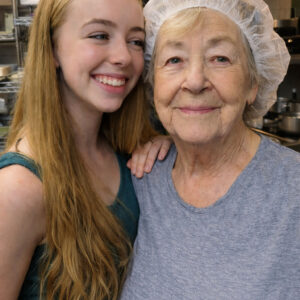
When I stepped up to the podium at graduation, I wasn’t planning to make anyone uncomfortable. I was supposed to talk about dreams and futures and inspirational quotes pulled from the internet. But as I looked out at the gym filled with classmates — some of the same people who had spent years laughing at my grandmother — something shifted. My grandma, Lorraine, had worked in that very building as the cafeteria cook. To them, she was just “the lunch lady.” To me, she was the woman who raised me after my parents died, who kept the lights on, who packed my lunches with handwritten notes that said things like, “You’re my favorite miracle.” And suddenly, I knew the speech I had written wasn’t the one I needed to give.
My grandmother took me in when she was already in her fifties, working long hours in the school cafeteria. She wore handmade aprons covered in strawberries and sunflowers, believing bright fabric could make a hard day softer. We didn’t have much money, but she never let me feel poor. When the heater broke, she turned it into a “spa night” with blankets and candles. When I needed a prom dress, she found one at a thrift store and stitched rhinestones on it by hand. At school, though, things were different. Students mimicked her accent, rolled their eyes at her kindness, and joked that she’d “spit in the soup” if someone upset me. They called me names because she still packed my lunch and kissed my cheek. What they didn’t realize was that she heard them — and chose kindness anyway.
The week before graduation, she suffered a heart attack. She never made it home from the hospital. Walking across that stage without her felt unreal, but she had saved for my graduation for months and pressed my gown weeks in advance. So when I took the microphone, I told the truth. I said, “Most of you knew my grandmother. She served you thousands of lunches. Tonight, I’m serving you something else — the truth.” I spoke about how she remembered allergies, birthdays, and who needed an extra apple. I spoke about how she raised me alone, worked through arthritis, and never stopped loving the same kids who laughed at her. “She heard every joke,” I said. “And she still chose kindness.” The gym went completely silent.
When I finished, the applause wasn’t loud — it was steady, thoughtful. Afterward, several classmates approached me, some in tears. They admitted they hadn’t thought about how their words affected her. They told me they wanted to create something lasting in her honor — a tree-lined walkway leading to the cafeteria, a peaceful place students could sit, to be named “Lorraine’s Way.” Standing in that hallway, I realized something my grandma had always known: people can grow. Later that night, I sat alone in our quiet kitchen and whispered that they were planting trees for her. For the first time since she passed, the silence didn’t feel quite so heavy. She had always told me I was her guiding star. In that moment, I understood she had been mine all along.